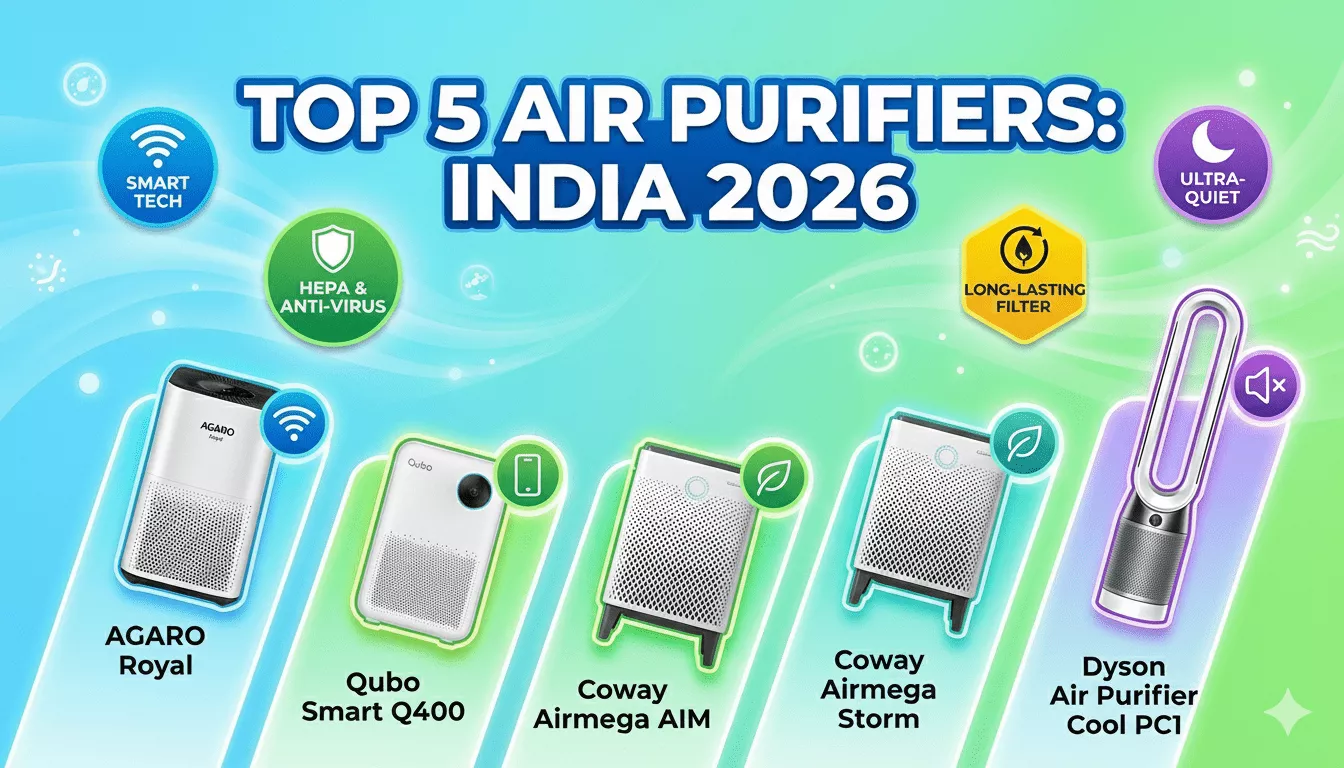
Best air purifier for Delhi pollution. Comparing Dyson, Qubo, Coway, Air purifier on AQI display, room size suitability, and filter price to find best fit.
Comparison Chart of Air Purifier
| ; | Dyson Cool PC1 | Coway Storm | Coway AIM (AP-0623B) | Qubo Smart Q400 | AGARO Royal |
Air Purifier 2026 | 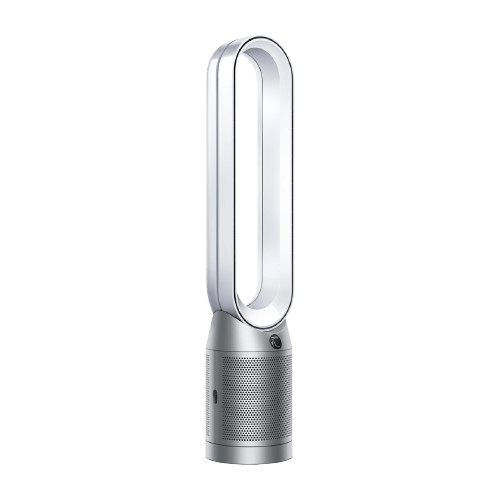 |  |  |  |  |
Room Area (Sq. Ft.) | 870 sq.ft. | 575 sq.ft. | 355 sq.ft. | 400 sq.ft. | 400 sq.ft. |
AQI Display | Yes (LCD) | No | Yes (LED) | Yes (App) | No |
Smart Controls | App + Voice + Remote | Touch Panel only | Remote + Touch | App + Voice | Remote + Touch |
Power (Watts) | 40W | 65W | 38W | 35W | 30W |
Noise Level | 42 – 62 dB | 22 – 49 dB | 22 – 50 dB | 25 – 55 dB | 30 – 55 dB |
Filter Replacement Cost (Approx.) | ₹4,990 | ₹3,499 | ₹3,499 | ₹2,290 | ₹1,799 |
Suitable for PM 2.5? | Yes (Captures 99.95%) | Yes (Captures 99.99%) | Yes (Captures 99.99%) | Yes (Captures 99.9%) | Yes (Captures 99.99%) |
Filters Included | HEPA H13 + | Pre-Filter + Carbon + Green HEPA | 3-in-1 (Pre + HEPA + Deodorization) | 4-Layer (Pre + Carbon + HEPA + Nano Silver) | 4-Stage (Pre + HEPA H13 + Carbon + Anion) |
Warranty | 2 Years | 1Y (Parts) / 7Y (Motor) | 1Y (Parts) / 7Y (Motor) | 1 Year | Not Mentioned |
Current Price | ; | ; | ; | ; | ; |
Table of Contents
Pro and Cons of Top 5 Air Purifier 2026
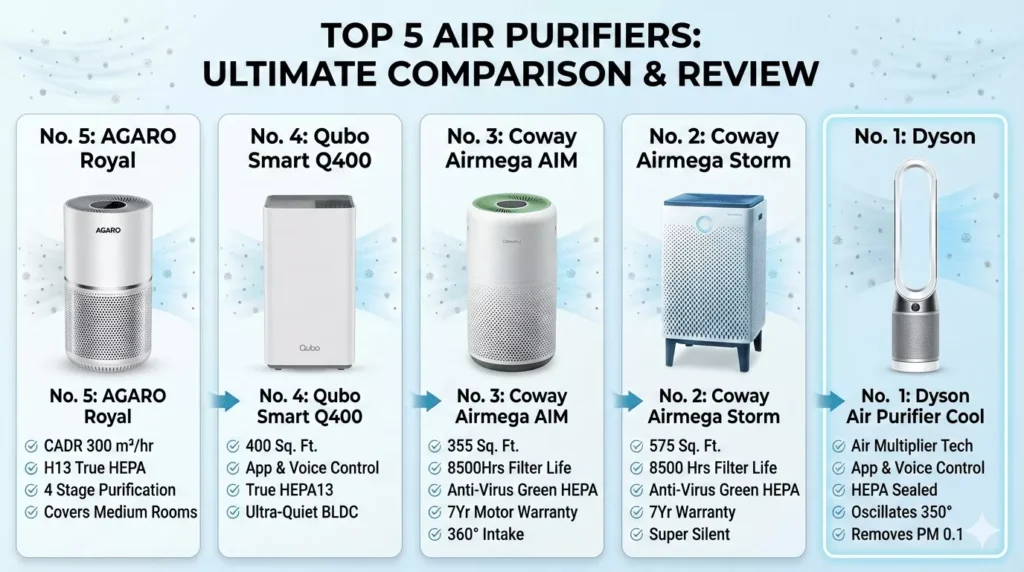
No.5: AGARO Royal Air Purifier
Pros |
|
Cons |
|
No.4: Qubo Smart Air Purifier Q400
Pros |
|
Cons |
|
No.3: Coway Airmega AIM (AP-0623B) Air Purifier
Pros |
|
Cons |
|
No.2: Coway Professional Air Purifier
Pros |
|
Cons |
|
No.1: Dyson Air Purifier Cool PC1
Pros |
|
Cons |
|
Air Purifier Buying Guide
There are three main things to consider when purchasing an air purifier.
- First is the type of filter that is used. True HEPA, HEPA 13 or HEPA 14 are good. Anything below is not good.
- Second is the filter replacement frequency and the replacement cost.
- Third, the room coverage and air change rate.
So let’s look at each one of them independently.
Filters of Air Purifier
The most important aspect of an air purifier, its filters.
There are three main types of filters in an air purifier.
▶️ First is the HEPA filter
It is really the heart of the air purifier. True HEPA, HEPA 13 or HEPA 14 filters capture particles as small as 0.3 microns with over 99.95% efficiency. This includes fine dust, pollen, pet hair and most airborne dust. So HEPA filter is beneficial.
Anything lower like HEPA 11 or HEPA 12 are not good enough.
▶️ Next is the pre-filters.
These catch big particles so that the more expensive HEPA filters life can be longer. Some brands like Sharp, Covey, Honeywell and Philips have washable pre-filters which is always convenient. Others can be vacuumed but they cannot be washed.
▶️ Next are the carbon filters
It typically help to tackle odours like cooking smells, smoke smells, agarbatti and it also tackles chemical smells like paint fumes and other volatile organic compounds. Every air purifier that I have included in this comparison includes carbon filtration. Recently when I painted my house while I was living in it, the smells were unbearable.
The carbon filters in the air purifier made it extremely tolerable. Other filtration aspects like UV LED which makes bacteria ineffective before releasing it back to the air and ionizers which release negative ions to make the purification faster are not a must have as a good HEPA filtration system already helps to purify the air well. Now let’s talk about filter replacement.
Filter Replacement Cost
Like water purifiers, filters in an air purifier also need to be replaced on a frequent basis to make sure that it works properly to purify the air. Compared to the upfront cost, the ongoing filter replacement cost and the filter availability should be considered when we are buying a new air purifier.
Honeywell, MI, Dyson except the Dyson Big and Quiet, Karcher and Philips have the filter life which is about 1 year or 3000 hours of usage whichever comes first.
In other words, if the air purifier is used for about 8 hours a day, the filters will need to be changed every year. On the other hand, Kovei, Sharp, Cubo, Agaro and Kuku have a filter life, 8500 to 9000 hours. In other words, if we use it for about 8 hours a day, the filters will last for 3 years.
And lastly, the Dyson Big and Quiet has a filter life of 5 years. Filter replacement is generally 2 to 3000 per year for most brands. Dyson has the most expensive replacement filters while other brands keep costs a little bit more reasonable.
The next important aspect is to consider the size of the room where the air purifier will be used.
Air Purifier for Different Room Size
While in my opinion, ideally the measure should have been cubic meter or cubic feet, most brands measure only the 2-dimensional room size. So how would you measure to get the right size for you? Measure the room length and width and add at least about 20% to get the coverage required for your room. For bedrooms or study rooms, you can consider a coverage up to 400 square feet.
For living and dining rooms, you can consider a coverage between 400 and 800 square feet. And for full house, you can consider upwards of 800 square feet. If you buy smaller coverage air purifier for a larger room, the purification will not be effective and air will not get clean fast enough.
On the other hand, if you buy larger coverage for a smaller room, the purification will be a lot faster. So it’s not just enough to buy a purifier that’s right for your room, it also needs to deliver clean air fast enough. The clean air delivery rate tells us how fast the air purifier can purify the room.
Most air purifiers that do publish the CADR numbers, If you are buying an air purifier for a large room, ensure that it has a large CADR.
If you need fast air purification, buying an air purifier meant for a larger room with a high CADR and using it in a smaller room will help purify it faster, like I mentioned earlier as well.
Extra features of Air Purifier
Also some brands do provide some extra features, but I consider these only a nice to have and not a must have. Some sharp models have mosquito catching feature which includes a 100% chemical free mosquito trap.
Interesting concept though we did consider this as a bonus rather than a primary purchasing factor. Most Dyson air purifiers also double up as bladeless fans for air circulation. This does not cool the room so don’t expect it to function as well as a fan does.
Some Dyson models also have heating but it does require a 16 amps power point.
Plus Most ACs have some basic level of air purification but it is not enough when the air quality is really poor. There is a brand which has introduced HEPA filters for your existing ACs.
By purifying 90% of PM2.5 particles, it is less effective than HEPA 13 or 14 filters which are in air purifiers which help to purify 99.95% plus of PM2.5 particles. But it is available at a fraction of the cost of an air purifier and does not need an extra appliance in your home. Value on a budget for sure.
Most Convenient Features in Air Purifier
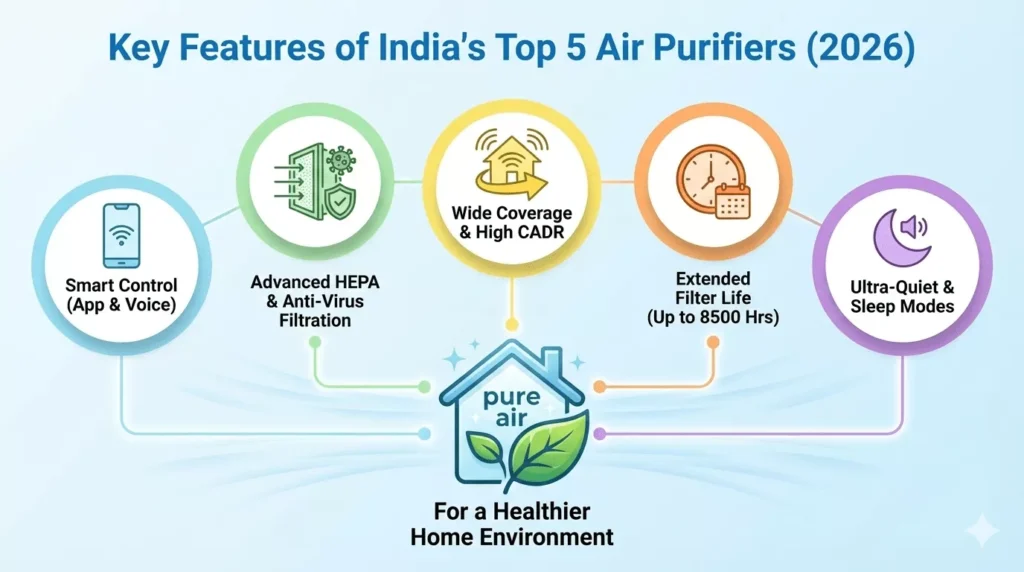
Let’s look at some of the convenience features. Most models feature the touch operation. Some models of Kovei, Xiaomi, Dyson, Karcher, Sharp and select Honeywell models also include a remote control.
Philips, Dyson, Qubo and some models of Honeywell include app connectivity which is useful for checking the filter status, real-time monitoring of the AQI or turning the unit on or off before you arrive at home. Most air purifiers display real-time AQI either numerically or through colour-coded indicators. Red typically signals poor air quality and triggers a really high-speed operation to clean the air faster.
Filter replacement alerts, night mode, child lock and other convenience features are there on most air purifiers.
FAQ
Is an air purifier actually effective against Delhi/NCR pollution?
Yes, but they aren’t magic. A purifier is only as good as the seal on your room. If you are in a city like Delhi or Ludhiana during smog season, the unit must have an H13 HEPA grade filter to trap the microscopic PM2.5 particles. Think of it like an AC, if the door is open, it won’t work. Keep the room airtight for the AQI to actually drop.
Can one air purifier clean my entire 2BHK or 3BHK house?
Air purifiers work on “Air Exchange Rates” within a confined space. Air doesn’t travel easily through hallways and around corners. It is far more effective to buy two or three compact units for individual bedrooms than one expensive heavy-duty model for the entire flat.
What is the monthly electricity bill for running an air purifier 24/7?
In India, running an air purifier is surprisingly cheap. Most modern units (especially those with BLDC motors) use about 30–50 Watts (approximately.), which is less than a standard ceiling fan. Even if you run it 24 hours a day, it typically adds only ₹200 to ₹400 (approx.) to your monthly utility bill, depending on your local slab rate.
Do indoor plants work better than air purifiers?
While NASA-approved plants like Snake Plants or Areca Palms improve oxygen levels, they cannot “filter” PM2.5 dust particles at the speed required for Indian pollution levels. To match the cleaning power of one CADR 300 purifier, you would need nearly 100 plants in a single room. So, better use a air purifier to inhale a healthy air.
